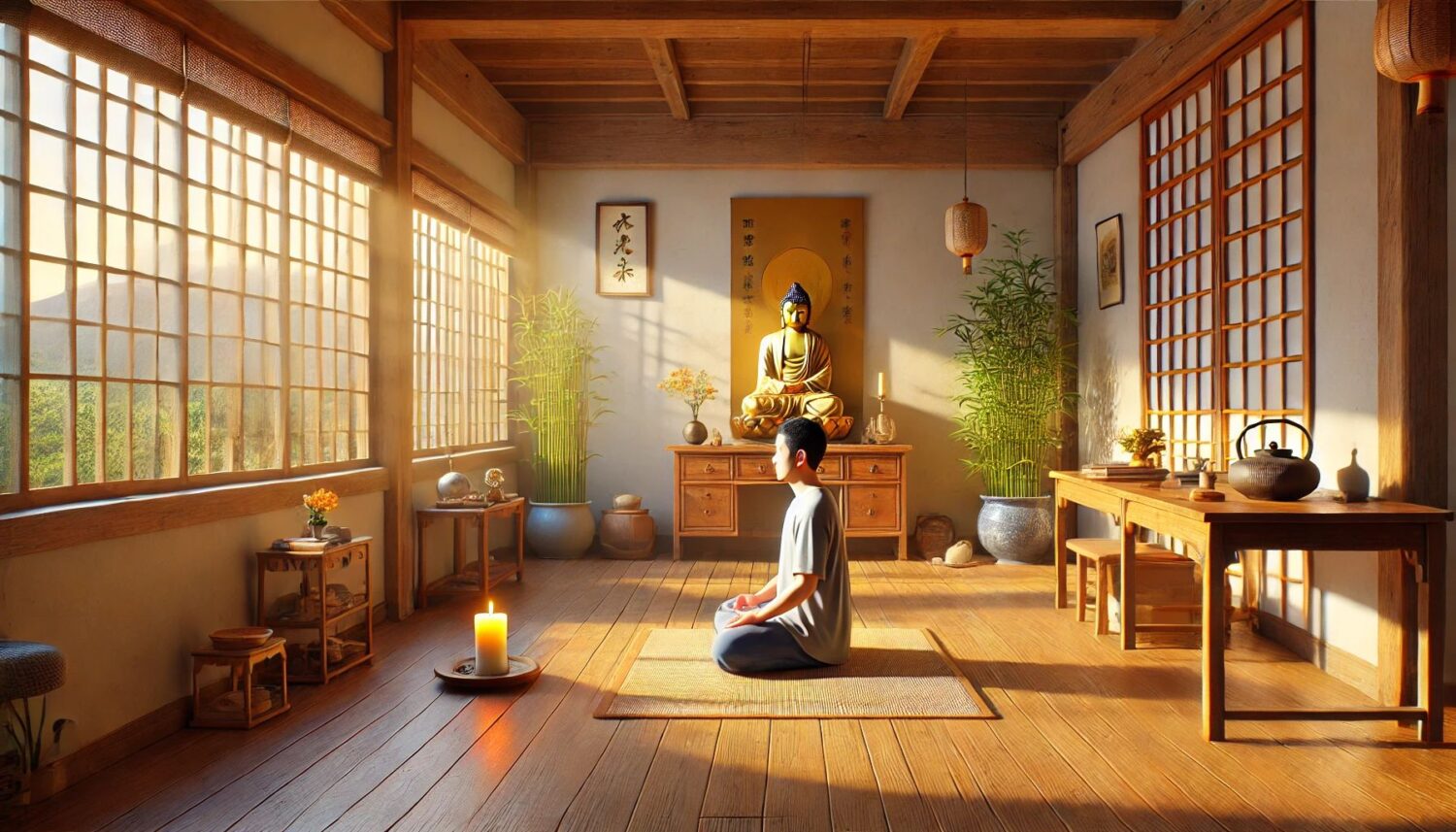
Date: 05/31/2025 06/01/2025
Location: Star Lake Meditation Center
Teacher: Shilin Long
Dharma Knowledge
The Path of Practice for Lay Practitioners
In many people’s minds, spiritual practice is closely associated with monastic life, secluded environments, and withdrawal from worldly affairs. As a result, lay life is often seen as an obstacle to genuine practice. From the fundamental perspective of the Dharma, however, practice is not determined by social status, but by the direction of the mind. The path of practice for lay practitioners is not a lesser alternative, but a complete and authentic path, distinguished only by the fact that its field of cultivation is everyday life itself.
The defining feature of lay practice is engagement rather than withdrawal. Family, work, relationships, and social responsibilities form the fabric of a layperson’s life. These do not disappear through practice; instead, they become the primary material for it. Practice does not aim to simplify life artificially, but to remain awake within complexity. When pressure arises, conflicts occur, or emotions fluctuate, the ability to notice without being fully swept away is at the heart of lay practice.
Lay practice does not depend on having long periods of quiet time. Rather, it makes use of ordinary and fragmented moments. Being aware while walking, recognizing intention while working, noticing tone while speaking, and observing reactions as emotions arise—these are all forms of practice. Practice does not exist only in designated sessions; it unfolds continuously within daily life. As long as awareness is present, practice has not ceased.
Ethical conduct plays a particularly practical role in lay practice. Lay practitioners are not required to adopt monastic discipline, but the Five Precepts and the Ten Wholesome Actions provide reliable guidance for living. When actions cause less harm and speech generates less conflict, life naturally becomes more stable. Ethical discipline is not a constraint that restricts lay life, but a safety net that protects relationships and inner balance. Observing it does not narrow life; it makes life more trustworthy and less burdened by regret.
Lay practice also directly engages with emotions and desire. Family bonds, intimate relationships, obligations, and attachments are integral to lay life. Buddhism does not reject these experiences, but invites them to be met with awareness and responsibility. When emotions are no longer driven by unconscious grasping, control, or avoidance, relationships become more genuine and resilient. Maturity in lay practice often shows itself in clarity and gentleness within relationships.
Because time and energy are limited, lay practice emphasizes correctness of direction rather than quantity of form. Short but consistent moments of mindfulness often carry more transformative power than occasional long sessions lacking continuity. The question is not how much one practices, but whether one is willing to return again and again to awareness and adjustment.
Lay practitioners sometimes assume that their conditions are inadequate and that meaningful practice must wait for a more ideal environment. In reality, these very limitations make practice more grounded. Without isolation, mental reactions reveal themselves more clearly; without protective roles or titles, habitual patterns are more easily exposed. Practice carried out under such conditions tends to be sturdy and integrated, rather than dependent on form.
Lay practice does not mean practicing alone. Listening to teachings, studying the Dharma, and associating with wholesome companions provide essential support. Yet their purpose is not to create reliance, but to help practitioners bring understanding back into their own lives. Ultimately, the value of practice must be verified in daily conduct, not merely affirmed in theory.
As lay practice matures, the boundary between practice and life gradually dissolves. Practice is no longer an additional activity, but becomes the quality of living itself. One acts with greater presence, relates with more sincerity, and meets difficulty with increased flexibility. These changes may be quiet and unremarkable, yet they are real and enduring.
Thus, the path of practice for lay practitioners is not a compromised path, but one that demands considerable courage. It requires repeatedly returning to awareness, responsibility, and compassion amid the complexities of ordinary life. Practiced in this way, the Dharma ceases to be merely an idea and becomes a living force that guides life toward clarity and freedom.