Date: 01/25/2025 01/26/2025
Location: Star Lake Meditation Center
Teacher: Shilin Long
Dharma Knowledge
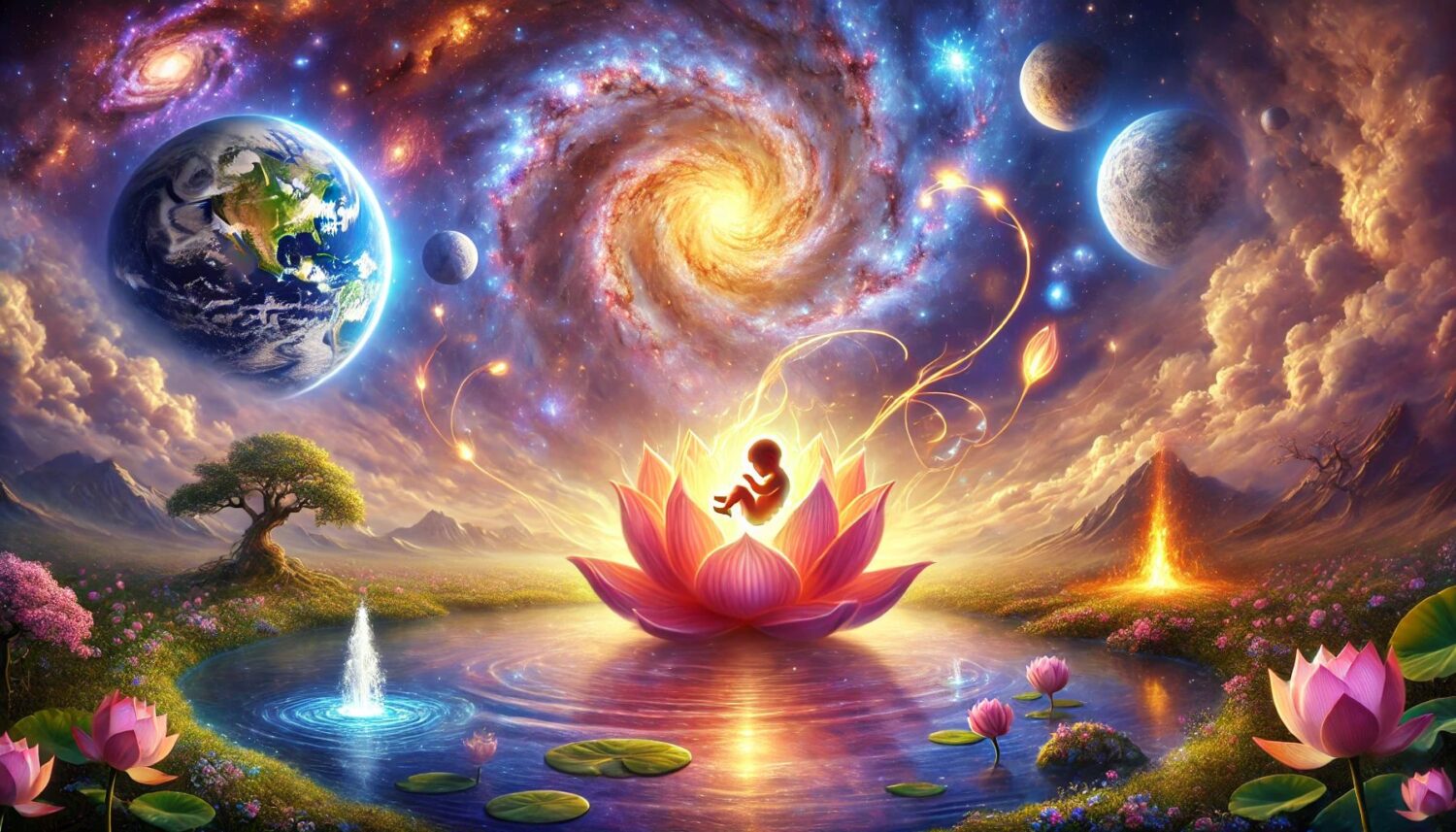
Where Does Birth Come From
“Where does birth come from?” is one of the oldest and most fundamental questions humanity has ever asked. It concerns not only the temporal beginning of life, but the meaning of existence itself. From a surface perspective, birth seems to begin with the union of parents and the formation of a physical body. Yet from the Buddhist viewpoint, such explanations remain incomplete. True “birth” is not merely the appearance of a body, but the manifestation of an ongoing flow of conditions.
From the perspective of dependent origination, birth does not arise suddenly from nothing, nor is it created by an eternal agent. It emerges from the convergence of causes and conditions. When necessary causes are present and supportive conditions mature, a new life naturally appears. Parents, genetics, environment, and society are visible conditions, but the deeper driving force lies in the continuity of karma and mental tendencies carried by consciousness. These unseen yet powerful factors make birth possible.
Buddhism teaches that what truly propels birth is not matter alone, but the continuity of the mind. The body is merely a vessel, while consciousness is the experiencer of the world. When one life ends, the body disintegrates, but consciousness does not simply cease. Carrying habitual patterns and karmic potential, it seeks new conditions to continue unfolding. This continuity is not a permanent soul, but a causal process, like a flame passed from one candle to another—connected, yet without a fixed entity that remains unchanged.
A deeper question then arises: why does consciousness continue to be reborn? The root lies in ignorance. Not understanding the true nature of existence, the mind assumes that being must take some form. Attachment to existence and fear of nonexistence drive consciousness to search for a new footing. It is within this unawareness that birth repeatedly occurs, appearing natural while being propelled by deep-seated clinging.
On an experiential level, birth does not happen only once. Every arising thought, every emerging emotion, every constructed identity represents a subtle form of birth. When these experiences are not clearly seen or released, they accumulate into forces that condition future existence. Thus, the origin of birth lies not only in the past, but in the present moment; not merely in external circumstances, but in internal reactions.
Buddhism does not regard birth as a fault, nor does it deny the value of life itself. The issue is not birth, but attachment to birth. When one clings tightly to life forms, identities, and experiences in search of lasting satisfaction, suffering inevitably follows. Because birth is inseparable from aging, illness, and death, clinging to birth is clinging to inevitable loss.
However, when wisdom illuminates the nature of conditions, the question “where does birth come from” loses its anxious urgency. Birth is no longer seen as a mysterious intrusion or a burden to resist, but as a natural manifestation when conditions converge. The mind no longer obsesses over beginnings or fears endings, resting instead in clear awareness of present conditions.
True liberation does not come from discovering a first birth, but from ending the ignorance that propels repeated rebirth. When the mind is no longer driven by attachment and no longer seeks self-confirmation through existence, birth loses its compulsive necessity. Life then ceases to be a forced cycle of beginnings and becomes a free unfolding within awakening.
Thus, the question “where does birth come from” ultimately points not to a final answer, but to a direction of insight. When one understands the conditional nature of birth and takes responsibility for present choices, life is no longer an unconscious continuation, but a path leading toward wisdom and peace.