Date: 11/16/2024 11/17/2024
Location: Star Lake Meditation Center
Teacher: Sara
Dharma Knowledge
What Is Samsara
Samsara is often understood as the transmigration of a soul through cycles of birth and death, or as rebirth into different realms after death. In the context of the Dharma, this understanding is inaccurate and obscures the core meaning of the concept. Samsara is not a mysterious cosmic mechanism, but a structural description of how suffering repeats itself when ignorance and attachment remain in operation.
Fundamentally, samsara is not about someone who reincarnates, but about processes that continue. The Dharma explicitly rejects the existence of a permanent, independent soul or self. If no such entity exists, then nothing “moves” from one life to another. Samsara refers to the continuation, reconfiguration, and re-arising of psycho-physical processes as long as their causal conditions are intact.
The driving forces of samsara are ignorance and attachment. Ignorance is a fundamental misperception of reality: mistaking impermanence for permanence, relational processes for entities, and the flow of experience for a fixed self. From this ignorance, attachment inevitably arises—clinging to sensations, identities, views, desires, and existence itself. This clinging propels action. Action generates karma. When karma matures, it conditions further experience. This entire chain functions without any external judge or divine will.
For this reason, samsara does not begin only after death. In the Dharma, samsara is first an immediately observable phenomenon: the repetition of emotional patterns, cycles of anxiety, the recurring loop of desire, gratification, and dissatisfaction, and the continual construction and collapse of identity. Birth-and-death samsara is the temporal extension of this same mechanism, not a myth detached from present experience.
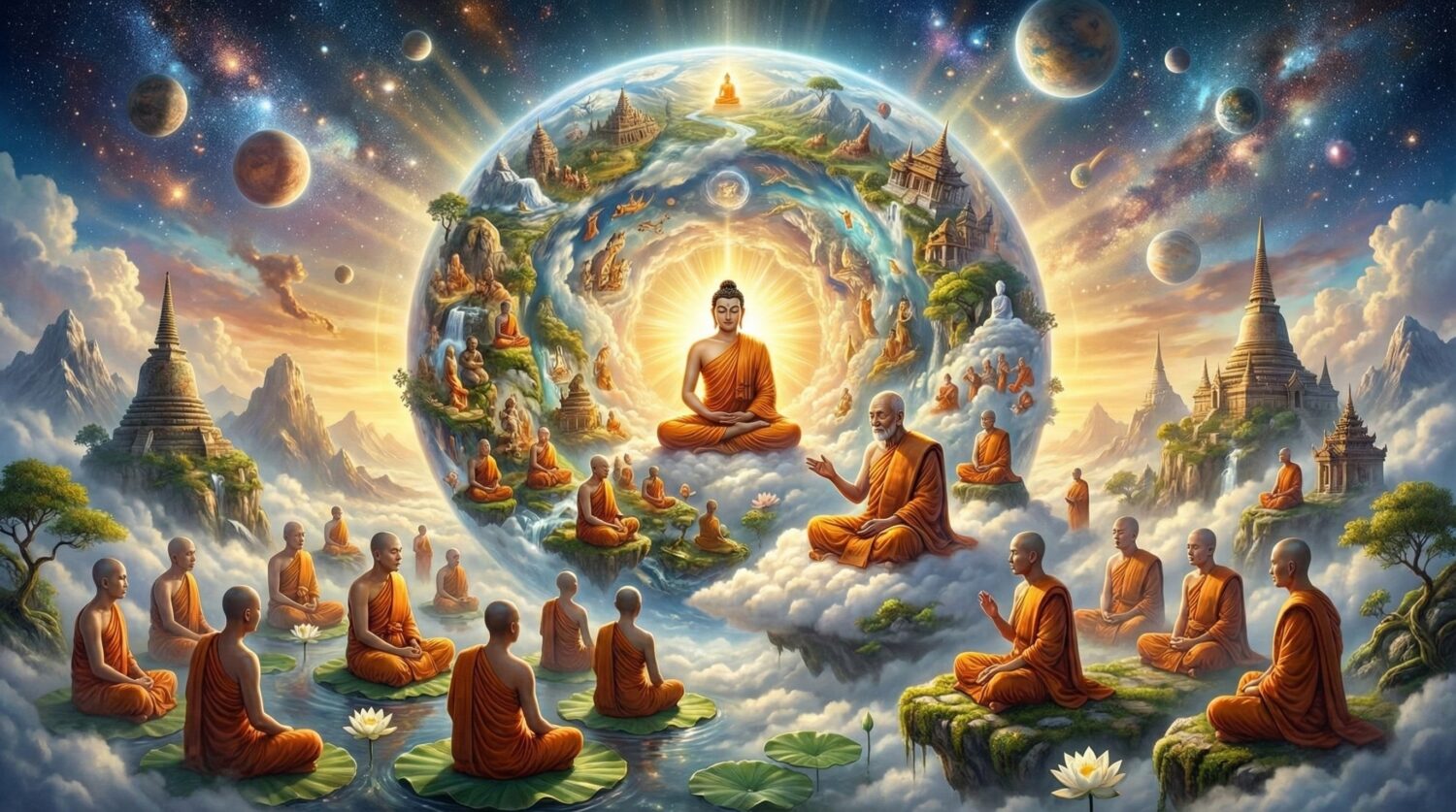
Classical texts describe samsara in terms of multiple realms of existence. These are not merely cosmological locations, but classifications of experiential states shaped by different psychological and behavioral structures. Intense greed, hatred, and delusion correspond to highly constrained and painful modes of existence; more balanced and ethical conditions correspond to less severe forms of suffering. Yet regardless of level, as long as ignorance persists, samsara itself remains unbroken.
Crucially, samsara is not a system of punishment or moral reward. It is causal, not judicial. There is no authority assigning destinations. There are only conditions producing results. Interpreting samsara as an external system of retribution moralizes the issue while obscuring its cognitive foundation.
The purpose of the Dharma’s teaching on samsara is not to instill fear or to construct a speculative cosmology. Its function is diagnostic. It reveals that as long as distorted cognition continues, suffering will recur in one form or another. Samsara is not fate; it is a process that can be brought to an end.
The end of samsara does not occur through escape from the world or annihilation of life, but through the cessation of ignorance. When reality is seen as it is, attachment loses its basis, and the causal chain that drives action and renewed becoming naturally ceases. This condition is called liberation or nirvana. It is not “going somewhere else,” but the non-arising of the samsaric mechanism itself.
Thus, samsara is not a doctrine about a future life, but an analytical tool for understanding how present cognition shapes future experience. To understand samsara is not to adopt a belief, but to see that identical conditions produce repeated results—and that when conditions change, repetition ends.