时间:01/17/2026 01/18/2026
地点:星湖禅修中心
主讲:龙示林
佛法修行
五百位婆罗门女净心得道缘
佛陀在舍卫国时,国土东南有海,海中突起一地,遍地尽是香花茂林,环境清幽雅致。
当时有五百位婆罗门女,虽然精勤修道,却不知有佛陀这位圣人。一日,她们聚在一起,相互告言:「我们今生得此女身,从少至老为诸多不自由所系缚,人命短促有如朝露,朝不保夕,无常逼迫甚不如意,倏忽即亡。我们不如前往东南海的香花台上采摘香花,祭祀梵天;并且精进持斋,祈求来世投生梵天,长寿不死,且得自在,远离忧苦。」言毕,婆罗门女立刻备齐各类供品,至香花台斋戒祭祀,企求梵天降临,满其所愿。
这时,在舍卫国的世尊,以神通力得知此五百女的心愿,其心虽同俗人,追求有为生灭之法,然其善根深厚,仍可前去度化。于是世尊带领大众弟子、菩萨及天龙鬼神,飞升虚空,来到海中的香花台,并且端坐于大树之下。五百婆罗门女顿时为这突来的异象所震慑,以为是大梵天王被她们的诚心所感动而慈悲降临,个个欢喜无比。此时,随佛同来的天人告诉她们说:「其实在你们面前的不是大梵天王,而是更尊贵的三界导师──佛陀,他以清净无为的佛法,度化了无量的众生。」
婆罗门女听了,立刻恭敬地顶礼佛陀,并且祈求:「我们因垢染深重,所以今世生为女人,希冀佛陀慈悲加持,能令我等投生梵天。」
佛陀说:「你们因宿植善根,所以今日才会发此愿心。世间有二件事昭然不隐,一是人间受苦、天道享乐,为善得福、作恶受殃;一是世间的快乐属于有为、有漏的福报,报尽还要堕落,令人烦忧,唯有寂灭无为的涅盘之乐,才是最究竟的快乐。」佛陀更进一步为其说偈:「知世坏喻,幻法忽有,断魔华敷,不现死生。见身如沫,幻法自然,断魔华敷,不现死生。」
五百婆罗门女至心听受偈语,善根成熟,即发出离心,顿时,头发自落,法衣着身,皆现清净比丘尼相。她们思惟着法理,凝然入定,烦恼断尽,当下即证阿罗汉果。
阿难尊者见其因缘殊胜,于是请示佛陀:「婆罗门女以何功德因缘,得值世尊前来度化?」世尊告诉阿难及在场大众:「过去迦叶佛时,有一位长者,家境富饶,拥有五百位夫人、彩女。可是长者生性多疑善妒,家中门禁森严,任何人都不得随意出入,就连夫人们欲前往礼拜供养佛陀,长者都断然拒绝。
直至一日,国王举办盛大的宴会,召请所有大臣入宫同欢,从日至暮歌舞不歇。五百位夫人、彩女见机不可失,趁着长者入宫时,前往拜见迦叶佛,并且聆听佛法。她们虔诚发愿:『愿我生生世世不与恶人相伴,所在之处恒遇有德圣者。来世有一释迦文佛,愿我等皆能在其座下出家修行,奉行修道。』」
佛陀告诉阿难:「当时的五百位夫人、彩女,就是你们眼前的五百比丘尼前生,因为愿心至诚恳切,因缘成熟,自然得度!」大众闻毕,咸皆欢喜赞叹佛法广大,一念至心,功德不可思议。
Date: 01/17/2026 01/18/2026
Location: Star Lake Meditation Center
Teacher: Shilin Long
Dharma Talk
The Karmic Cause by Which Five Hundred Brahmin Women Purified Their Minds and Attained the Path
When the Buddha was residing in Śrāvastī, to the southeast of the country there was a sea, within which suddenly rose a landmass. Everywhere it was covered with fragrant flowers and luxuriant forests, and the surroundings were tranquil and elegant.
At that time there were five hundred Brahmin women who, although diligently cultivating ascetic practices, did not know of the Buddha, the noble sage. One day they gathered together and told one another: “In this life we have obtained female bodies, and from youth to old age we are bound by many forms of constraint and lack of freedom. Human life is short, like morning dew, uncertain from dawn to dusk.
Impermanence presses upon us, and things rarely go as we wish; in an instant we may perish. It would be better for us to go to the Fragrant Flower Terrace in the southeastern sea to gather fragrant flowers and offer sacrifices to Brahmā, and to diligently observe fasting and discipline, praying that in a future life we may be reborn in the Brahmā heaven, live long without death, gain freedom, and be far removed from sorrow and suffering.”
After saying this, the Brahmin women immediately prepared all kinds of offerings and went to the Fragrant Flower Terrace to observe fasting and perform sacrifices, hoping that Brahmā would descend and fulfill their wishes.
At this time, the World-Honored One in Śrāvastī, by means of his supernatural powers, knew the aspirations of these five hundred women. Although their minds were still like those of ordinary people, seeking conditioned and impermanent dharmas, their wholesome roots were deep, and they could still be transformed.
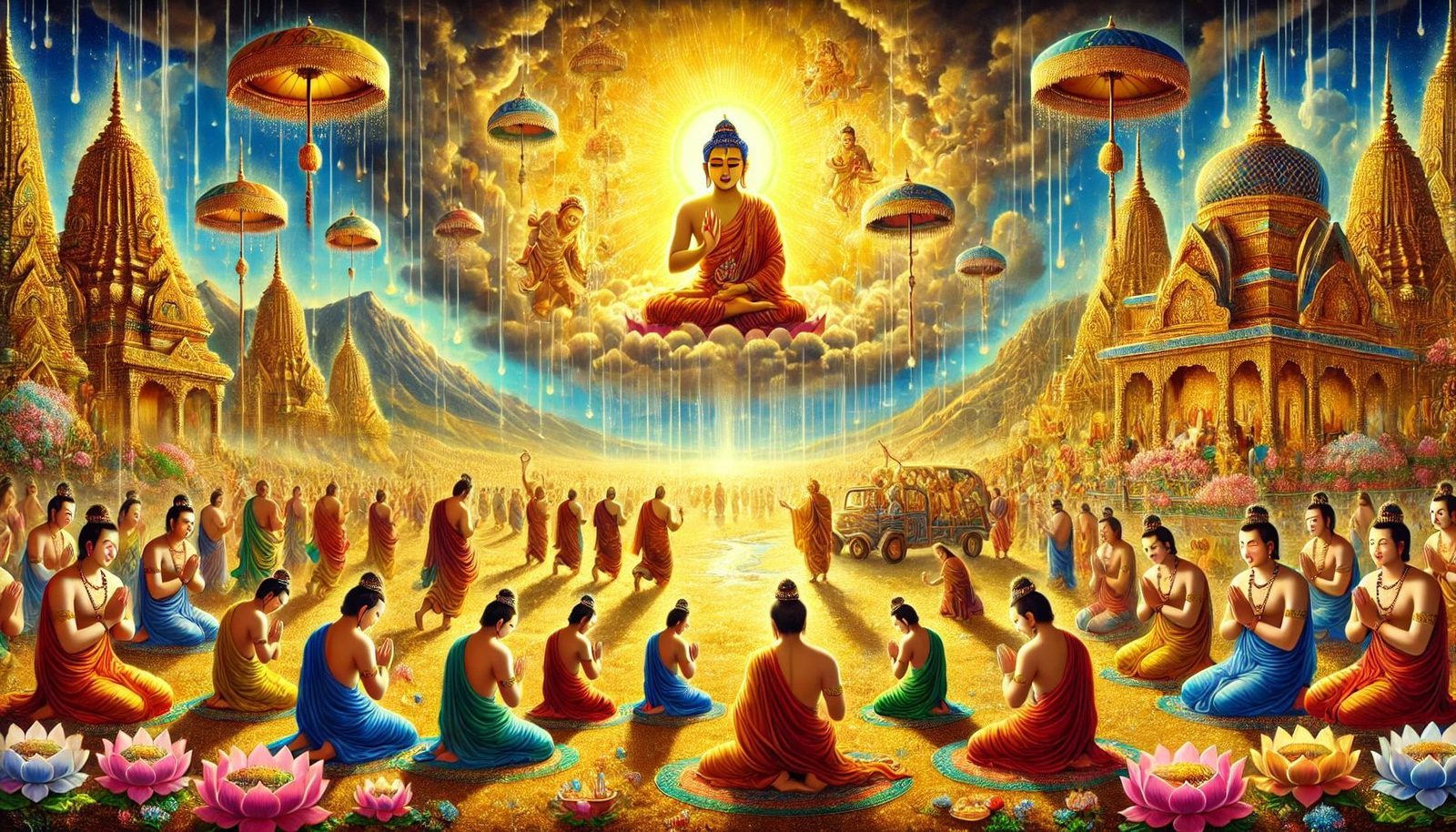
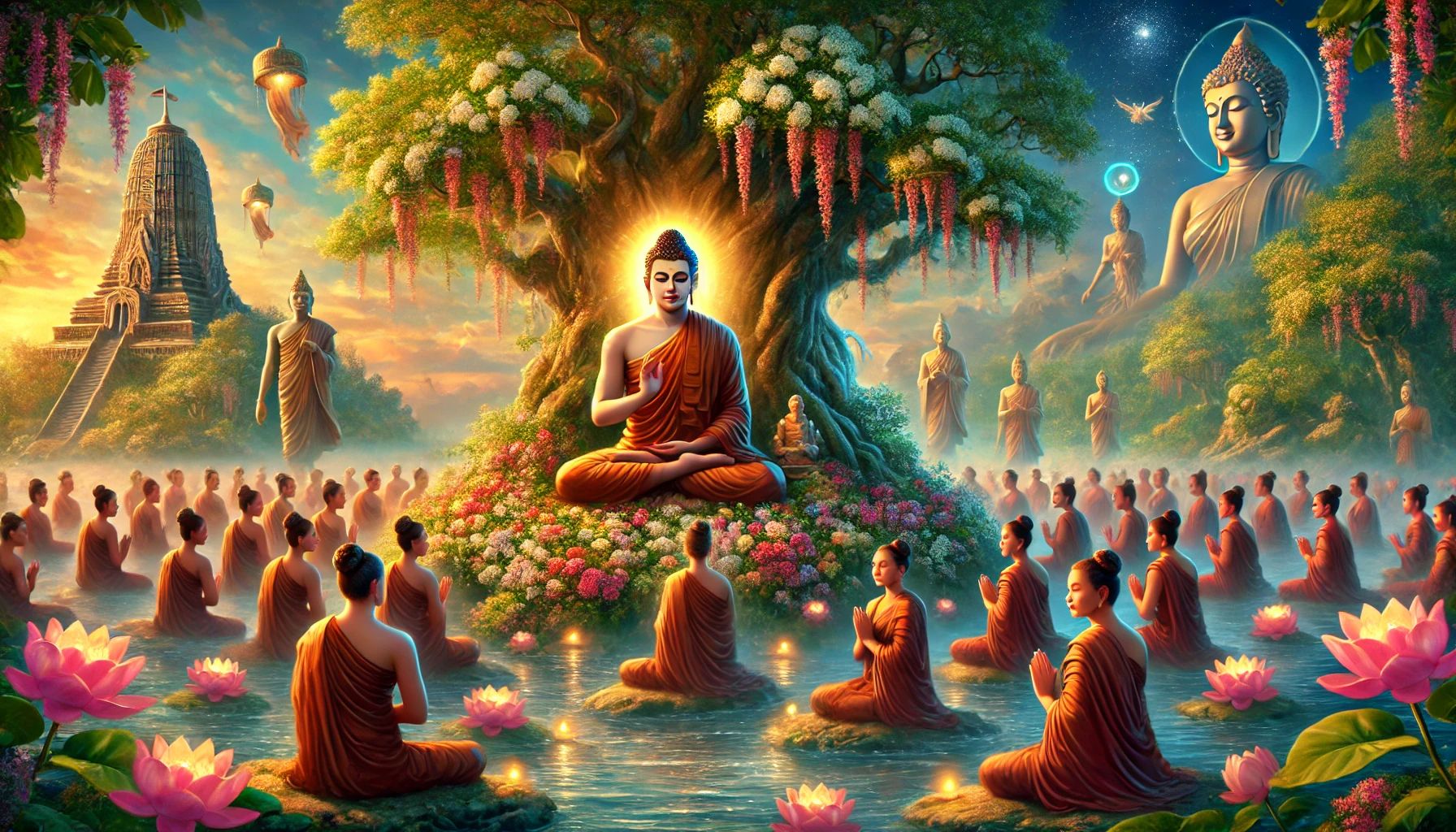
Therefore, the World-Honored One led the great assembly of disciples, bodhisattvas, and devas, nāgas, and spirits, ascended into the sky, and came to the Fragrant Flower Terrace in the sea, where he sat upright beneath a great tree.
The five hundred Brahmin women were immediately shaken by this sudden and extraordinary sight, believing that the Great Brahmā King had been moved by their sincerity and had compassionately descended, and each of them rejoiced greatly.
At this moment, the heavenly beings who had come together with the Buddha told them: “What stands before you is not the Great Brahmā King, but an even more venerable teacher of the three realms—the Buddha, who with his pure and unconditioned Dharma has liberated countless beings.”
Upon hearing this, the Brahmin women immediately paid reverent prostrations to the Buddha and prayed: “Because our defilements are deep and heavy, in this life we have been born as women. We hope that the Buddha, in his compassion, will grant us empowerment so that we may be reborn in the Brahmā heaven.”
The Buddha said: “Because you have planted wholesome roots in past lives, you are able today to give rise to such aspirations.
In the world there are two matters that are clearly evident: first, that humans experience suffering while the heavenly realms enjoy pleasure—doing good brings blessings, and doing evil brings retribution; second, that worldly happiness belongs to conditioned and tainted blessings—when such rewards are exhausted, one falls again, giving rise to distress.
Only the bliss of nirvāṇa, which is quiescent and unconditioned, is the most ultimate happiness.” The Buddha further spoke a verse for them:
“Knowing the world’s decay is like an illusion,
Phantasmal dharmas suddenly arise;
Cut off Māra’s flowery adornments,
And birth and death no longer appear.
Seeing the body as foam,
Illusory dharmas are thus by nature;
Cut off Māra’s flowery adornments,
And birth and death no longer appear.”
The five hundred Brahmin women listened with utmost sincerity to the verse. Their wholesome roots matured, and they gave rise to the mind of renunciation. Immediately, their hair fell away, Dharma robes clothed their bodies, and they all manifested the pure appearance of bhikṣuṇīs. Contemplating the principles of the Dharma, they calmly entered meditation, cut off all afflictions, and at once attained the fruit of arhatship.
Venerable Ānanda, seeing the exceptional nature of these causes and conditions, asked the Buddha: “By what meritorious causes and conditions did these Brahmin women encounter the World-Honored One coming to liberate them?”
The World-Honored One told Ānanda and the assembly: “In the time of Buddha Kāśyapa in the past, there was an elder whose household was wealthy, possessing five hundred wives and maidservants. However, the elder was by nature suspicious and jealous, and the household was strictly guarded, allowing no one to enter or leave freely.
Even when the wives wished to go to pay homage and make offerings to the Buddha, the elder firmly refused. Until one day, when the king held a grand banquet and summoned all the ministers to the palace to celebrate, with singing and dancing continuing from day until night, the five hundred wives and maidservants seized the opportunity, and while the elder was in the palace, they went to pay respects to Buddha Kāśyapa and listen to the Dharma.
They sincerely made the vow: ‘May we, life after life, not associate with evil people, and wherever we are, always encounter virtuous and noble beings. In a future life, when there is a Buddha named Śākyamuni, may we all be able to go forth and practice under him, upholding the path of cultivation.’”
The Buddha told Ānanda: “Those five hundred wives and maidservants at that time are the previous lives of the five hundred bhikṣuṇīs you see before you now. Because their vows were sincere and earnest, when the causes and conditions matured, they were naturally liberated.”
When the assembly heard this, all rejoiced and praised the vastness of the Buddhadharma, realizing that with a single sincere thought, the merit is truly inconceivable.