时间:01/27/2024 01/28/2024
地点:星湖禅修中心
主讲:Lucy Zhou
佛法修行
久离恐怖的佛陀
有一次,佛陀在摩揭陀国游化,住在摩鸠罗山。那时,佛陀身边的侍者还不是尊者阿难,而是尊者那伽波罗。
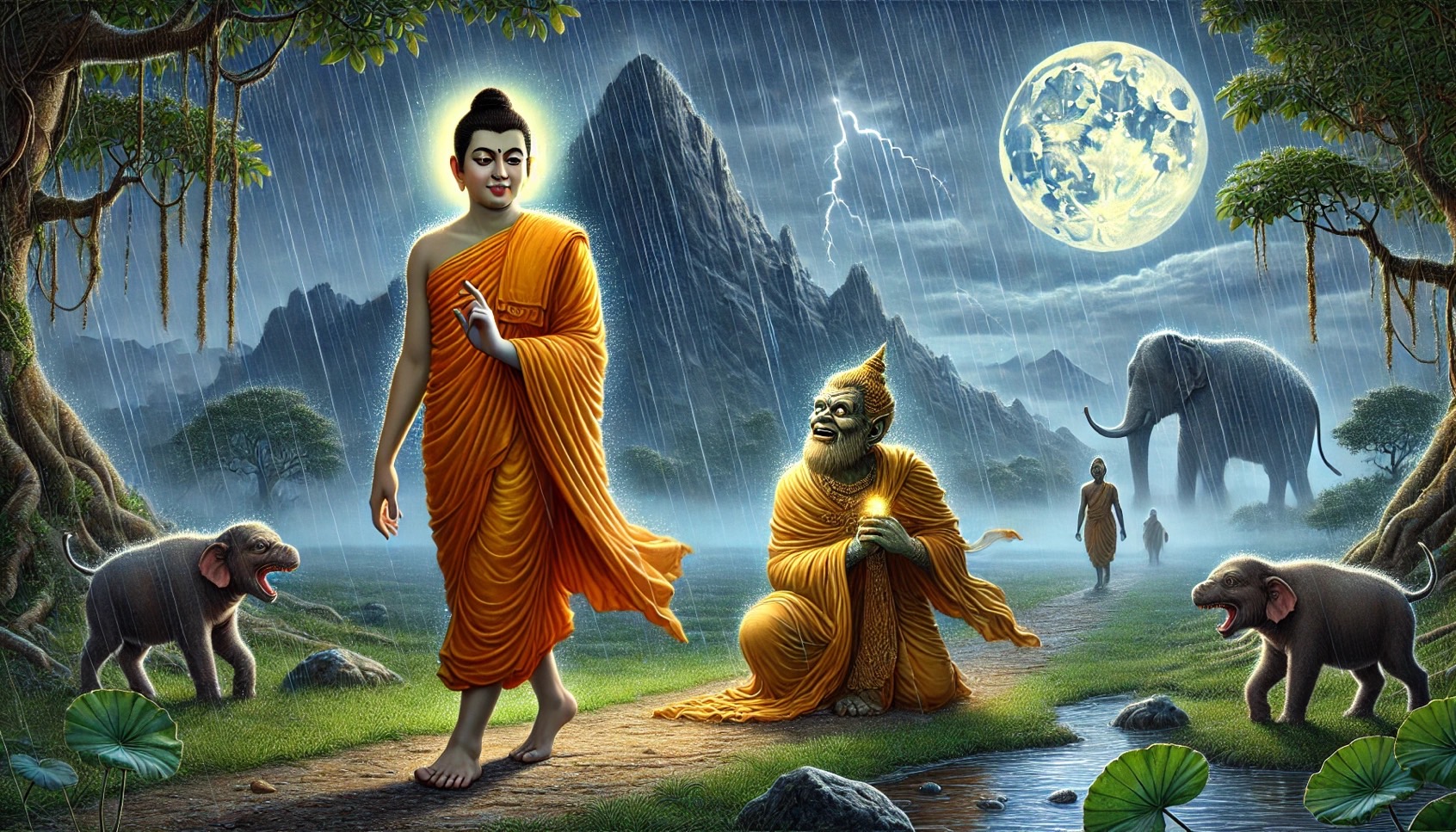
这天傍晚,天色才暗,天空飘着细雨,又有间歇的闪电,佛陀在室外的空地上经行。
这时,三十三天的统领释提桓因,知道佛陀在屋外经行,于是变化出一座毘琉璃宝塔,带着去拜见佛陀,以表示对佛陀的崇敬。当他见过佛陀,向佛陀顶礼后,就跟随在佛陀后面经行。
佛陀为了提供天帝释多一些经行的机会,所以经行的时间,比平常要久。尊者那伽波罗看不到佛陀后面的天帝释,更不知道佛陀比平常经行的时间久,是为了天帝释。而依据当时的惯例,侍者要等到所侍奉的老师结束禅修后,才能去睡觉,所以尊者那伽波罗一直没办法就寝。
或许是因为感到太疲惫了,尊者那伽波罗开始想办法要让佛陀停止经行,以便自己可以赶快去睡觉。当时,摩揭陀国人有一个习俗:当小孩子夜间哭闹不停时,大人们便说,住在摩鸠罗山的摩鸠罗鬼来了,小孩就会害怕而停止哭闹。
尊者那伽波罗竟然异想天开,想装成摩鸠罗鬼来吓佛陀,以为佛陀会害怕而停止经行。于是,尊者那伽波罗就将一件毛织物翻转过来,披在身上,让自己身上看起来像是长满了长毛的摩鸠罗鬼,然后躲到佛陀经行小路的尽头处,准备吓佛陀。
当佛陀走过来时,尊者那伽波罗就跳出来,对着佛陀大喊:「摩鸠罗鬼来了!摩鸠罗鬼来了!」来吓佛陀。
佛陀当然不会被吓着,于是对尊者那伽波罗说:「那伽波罗,你这个愚痴人!想以摩鸠罗鬼的样子来吓如来吗?那是连一根毛发也撼动不了我的,我离恐怖已经很久了。」
这时,跟随在佛陀后面经行的天帝释对佛陀说:「世尊!僧团里也有这种人吗?」
佛陀回答说:「憍尸迦!僧团中广纳各类不同根性的人,他们在未来,都会成就清净之法的。」
按语:
一、本则故事取材自《杂阿含第一三二○经》、《别译杂阿含第三一九经》。
二、出现在《阿含经》的佛陀侍者,计有尊者优波摩、尊者罗陀、尊者弥醯、尊者那伽波罗,以及尊者阿难等五位,其中,以尊者阿难侍佛时间最久,依《中阿含第三三侍者经》说共有二十五年,亦即在佛陀五十五岁到八十岁的这段期间。
三、如果再依《根本说一切有部毘奈耶》(大正大藏经第二三册第六二八页上栏),佛陀成佛后的最初十二年间,没有制定戒律,其原因是,在这段期间来跟随佛陀修学的比丘,程度很好,没有人曾犯有过失,所以尊者那伽波罗加为佛陀侍者的时间,也不太可能是在最初的十二年内。因此推断本则故事发生的时间,以佛陀成佛后十二到二十年的八年间最有可能。
四、尊者那伽波罗是怎样的一位比丘呢?在《阿含经》中有关他的经文并不多,仅在《增壹阿含第四品第一○经》中说他是「我声闻中第一比丘晓了星宿,预知吉凶」。这样的描述,就佛法的律制标准来说,并不太光彩,因为那不是佛陀鼓励比丘们应当学的。而在《增壹阿含第四一品第二经》中,则可以看出那时的尊者那伽波罗,已经是证入解脱的圣者了。
该段经文描述了一段相当稀有的事件:有一位尊者那伽波罗小时候的好友来见他,向尊者述说他近来七天里,死了七个有才华的儿子,近六日来死了十二个能干的佣人,近五日来死了四个各有专长的兄弟,近四日来死了百岁年迈的双亲,近三日来死了两位贤慧的太太,昨天,家中的财宝也被偷了,真是遭逢了人生最大的打击,痛苦极了,然后羡慕尊者那伽波罗,赞叹是「快乐中最快乐的人」。尊者那伽波罗就为他的朋友说了解脱之法,引导他也证入解脱,成为阿罗汉。
五、经行,是在一段距离适中的空地或小径上,缓慢地往返步行,也有在室内进行的。通常是在饭后,或在禅坐中感到昏沈疲倦时来做,其目的,除了有调剂作用外,还是不离「摄心」与「觉察」。
六、天帝释,又译为释提桓因、因陀罗、释迦因陀罗,依《杂阿含第一三二○经》、《杂阿含第五○四经》、《杂阿含第五五二经》、《杂阿含第一一○六经》等经的叙述,知道「憍尸迦」(《中阿含第一三四释问经》等译为「拘翼」)是他过去世为人时的姓,因为其乐善好施,死后生天,为三十三天──忉利天的领袖,这相当于台湾民间信仰中的「玉皇大帝」。
天帝释在佛世时经常来人间亲近佛陀与佛弟子,听闻佛法,只是三十三天环境太好,娱乐太多,依《杂阿含第五○五经》帝释天自己告诉尊者大目键连说,他们「多着放逸乐」,所听闻的佛法也时忆时忘。
七、在《阿含经》中,经常记载着天帝释以及他所领导的三十三天天子,常来人间听闻佛法,向佛陀及佛弟子学习,这与后来佛弟子们逐渐倾向依靠天神庇护的情形不同。
八、远离恐怖,这是解脱圣着的模样。其实不只解脱的圣者,即使是刚入圣者之流的「初果」者,就能自说「于正法中得无所畏」,所以佛陀会说他已「久离恐怖」了。
Date: 01/27/2024 01/28/2024
Location: Star Lake Meditation Center
Teacher: Lucy Zhou
Dharma talk
The Buddha, Long Free from Fear
On one occasion, the Buddha was traveling in the Kingdom of Magadha and staying on Mount Makula. At that time, the Buddha’s attendant was not yet Venerable Ānanda, but Venerable Nāgabala.
That evening, as dusk fell, a fine rain drifted down from the sky, accompanied by intermittent flashes of lightning. The Buddha was practicing walking meditation in an open area outdoors.
At that time, Śakra Devānām Indra, the ruler of the Heaven of the Thirty-Three, knew that the Buddha was practicing walking meditation outside. He therefore manifested a jeweled tower of lapis lazuli and came to pay his respects to the Buddha, as an expression of reverence. After meeting the Buddha and paying homage to him, Śakra followed behind the Buddha in walking meditation.
In order to give Śakra more opportunity to practice walking meditation, the Buddha continued for longer than usual. Venerable Nāgabala could not see Śakra behind the Buddha, nor did he know that the Buddha had prolonged his walking meditation for Śakra’s sake. According to the custom at that time, an attendant could not go to sleep until the teacher he was serving had finished his meditation practice. As a result, Venerable Nāgabala was unable to retire and rest.
Perhaps because he was extremely tired, Venerable Nāgabala began to think of a way to make the Buddha stop walking meditation so that he himself could quickly go to sleep. Among the people of Magadha, there was a folk custom: when children cried incessantly at night, adults would say that the Makula ghost from Mount Makula had come, and the children, frightened, would stop crying. Venerable Nāgabala, in a moment of foolish inspiration, thought of disguising himself as the Makula ghost to scare the Buddha, believing that the Buddha would be frightened and thus stop walking meditation.
Accordingly, Venerable Nāgabala turned a woolen garment inside out and draped it over himself, making his body appear covered with long hair like the Makula ghost. He then hid at the far end of the path where the Buddha was walking, waiting to frighten him.
When the Buddha approached, Venerable Nāgabala jumped out and shouted loudly, “The Makula ghost has come! The Makula ghost has come!” attempting to frighten the Buddha.
Of course, the Buddha was not frightened at all. He said to Venerable Nāgabala, “Nāgabala, you foolish man! Do you think you can frighten the Tathāgata by imitating the Makula ghost? You cannot even stir a single hair on me. I have long been free from fear.”
At that moment, Śakra, who was following behind the Buddha in walking meditation, said to him, “Blessed One, are there such people even within the Saṅgha?”
The Buddha replied, “Kauśika, the Saṅgha accepts people of many different dispositions and capacities. In the future, all of them will accomplish the pure Dharma.”
Notes
1.This story is drawn from Saṃyukta Āgama, Sūtra 1320, and Alternate Translation of the Saṃyukta Āgama, Sūtra 319.
2.According to the Āgama texts, there were five monks who served as the Buddha’s attendants at different times: Venerable Upamā, Venerable Rādha, Venerable Meghiya, Venerable Nāgabala, and Venerable Ānanda. Among them, Venerable Ānanda served the Buddha for the longest period. According to Madhyama Āgama, Sūtra 33, “The Discourse on the Attendant,” this period lasted twenty-five years, from the Buddha’s age of fifty-five to eighty.
3.According to the Mūlasarvāstivāda Vinaya (Taishō Tripiṭaka, Vol. 23, p. 628, upper column), during the first twelve years after the Buddha’s awakening, no monastic rules were established. This was because the monks who followed the Buddha during that period were of high caliber and none committed any offenses. Therefore, it is unlikely that Venerable Nāgabala served as the Buddha’s attendant during those first twelve years. It is most plausible that this story took place between twelve and twenty years after the Buddha’s awakening.
4.What kind of monk was Venerable Nāgabala? References to him in the Āgama texts are few. In Ekottarika Āgama, Book 4, Sūtra 10, he is described as “the foremost among my disciples in understanding the stars and foreknowing auspicious and inauspicious events.” By the standards of Buddhist discipline, this description is not particularly commendable, as such practices were not encouraged by the Buddha. However, in Ekottarika Āgama, Book 41, Sūtra 2, it can be seen that at that time Venerable Nāgabala had already realized liberation as a noble one.
This passage records a rather rare event: a childhood friend of Venerable Nāgabala came to see him and recounted a series of devastating losses—within seven days, seven talented sons had died; within six days, twelve capable servants had died; within five days, four brothers skilled in various arts had died; within four days, his elderly parents, both over a hundred years old, had died; within three days, two virtuous wives had died; and just the day before, the family’s wealth had been stolen. Having suffered what he considered the greatest blow of his life, he was overwhelmed with pain. Yet he admired Venerable Nāgabala and praised him as “the happiest among the happy.” Venerable Nāgabala then taught him the Dharma of liberation, guiding him to realize liberation as well and become an arahant.
5.Walking meditation consists of slowly pacing back and forth over a moderate distance, either outdoors or indoors. It is usually practiced after meals or when drowsiness arises during seated meditation. Its purpose is not only to refresh the body but also to maintain mental collectedness and mindfulness.
6.Śakra, also translated as Śakra Devānām Indra, Indra, or Śakya-Indra, is identified in texts such as Saṃyukta Āgama Sūtras 1320, 504, 552, and 1106. The name “Kauśika” (translated in Madhyama Āgama Sūtra 134 as “Kuyi”) is said to have been his family name in a previous human life. Because he delighted in generosity, after death he was reborn in the Heaven of the Thirty-Three (Trāyastriṃśa) as its ruler—comparable to the Jade Emperor in Taiwanese folk belief.
During the Buddha’s lifetime, Śakra frequently came to the human world to associate with the Buddha and his disciples and to listen to the Dharma. However, life in the Heaven of the Thirty-Three was extremely pleasant and full of entertainment. As Śakra himself told Venerable Mahāmaudgalyāyana in Saṃyukta Āgama Sūtra 505, they “are often attached to heedless pleasures,” and thus what they hear of the Dharma is remembered at times and forgotten at others.
7.The Āgama texts often record that Śakra and the devas of the Heaven of the Thirty-Three regularly came to the human world to hear the Dharma and learn from the Buddha and his disciples. This differs from later tendencies among some Buddhists to rely on divine protection.
8.Freedom from fear is a hallmark of liberated noble ones. In fact, not only fully liberated saints but even those who have just entered the stream (stream-enterers) can declare that they have “attained fearlessness in the true Dharma.” For this reason, the Buddha could rightly say that he had “long been free from fear.”