时间:12/02/2023 12/03/2023
地点:星湖禅修中心
主讲:Lucy Zhou
佛法修行
怎样才是真正的赞叹佛陀
有一次,佛陀和追随他的比丘弟子们,在印度当时的摩揭陀国境内游化,打算从首都王舍城,前往北边的那烂陀城。
在佛陀与比丘们一行人的后面,有一对外道沙门师徒,正好也同路,为师的名叫「须卑」,徒弟名叫「梵达摩纳」。一路上,那位老师一直不停地诽谤佛陀,也诽谤佛法与比丘们,而他的徒弟却一直与他唱反调,不断地称赞佛陀、佛法与比丘们。
这一天傍晚,大家都来到路途中的一个庵婆罗树园内,准备在园内国王建的公共房舍过夜。即使到了这个时候,这对外道沙们师徒,还没能停止他们谤佛、赞佛的争论。这个情况,让比丘们不禁对这两位奇怪的师徒议论起来。大家都认为,相对于这位外道老师的不了解徒弟,佛陀的善知人们志趣,是多么的稀有难得啊!
佛陀知道比丘们在讲堂聚集,就来询问他们到底在议论什么。于是,比丘们将他们议论的原委,告诉了佛陀。
佛陀因而教导比丘们说:
「比丘们!如果听到别人诽谤如来、佛法和僧团,大家不要忧愁、伤心,也不要因此而愤怒,甚至怀恨在心而意图报复,因为,这样只会带给大家障碍,不能如实地判断别人所说的是有道理的,还是错误的。反之,听了别人赞叹如来、佛法和僧团,也不要感到欣悦、愉快,因为,这也会带给大家障碍,不能如实地判断别人所说的是有道理的,还是错误的。」
接着,佛陀又说:
「比丘们!一般凡夫,都只从一些细琐、微小、世俗的戒行,例如五戒、十善、俭朴严谨的正命生活、乞食、不蓄积财物等来赞叹如来而已,不能从如来所证得的深奥、微妙、大光明之法这一方面来赞叹佛陀。只有从如来所证得的深奥、微妙、大光明之法来赞叹,才是真正如实的赞叹如来。」
什么是如来所证得的深奥、微妙、大光明之法呢?佛陀那个时代的沙门、婆罗门们,有着种种的邪知、邪见,总括归纳起来,不外乎是全然的常见,部分的常见,无因、无缘论,有边、无边论,不定诡辩论,有想论,无想论,非有想非无想论,断灭论,不正确的现法涅槃论等,共十类六十二种,称为「六十二见」。
这六十二见的归纳,就像洒在小池塘中的大渔网,网住了世间所有的邪知、邪见。而佛陀所证的深奥、微妙、大光明之法,就是远离了这六十二见,在日常生活六根对六境的认识过程中,如实知认识与感受生起的真正原因,以及其所引发烦恼的根除方法:认识与感受,是如何地让人们因贪爱而陷入味着,味着又如何在无常变化下转为祸患,圣者又如何从中超越与出离。
由于能超越与出离,所以圣者切断了推动流转到下一生的根,就像斩断一棵枝叶茂密的大树树根,这棵树就随之枯萎,永远不再生一样,这就是佛陀所证的深奥、微妙、大光明之法。
能够从这里来赞叹佛陀,才是真正的赞叹。
Date: 12/02/2023 12/03/2023
Location: Star Lake Meditation Center
Teacher: Lucy Zhou
Dharma talk
What It Truly Means to Praise the Buddha
On one occasion, the Buddha and the bhikkhus who followed him were traveling within the Kingdom of Magadha in India, intending to go from the capital city Rājagaha northward to Nāḷandā.
Behind the Buddha and the community of bhikkhus, there happened to be a pair of non-Buddhist wandering ascetics—a teacher and his disciple—traveling the same road. The teacher was named Suppiya, and the disciple was named Brahmadatta. Along the way, the teacher continually slandered the Buddha, the Dharma, and the community of bhikkhus, while his disciple consistently contradicted him, repeatedly praising the Buddha, the Dharma, and the Saṅgha.
That evening, everyone arrived at a mango grove along the road, where a public lodging built by the king stood, and they prepared to spend the night there. Even at this point, the non-Buddhist teacher and disciple had not ceased their dispute—one slandering the Buddha, the other praising him. This situation led the bhikkhus to discuss the two unusual ascetics among themselves. They all felt that, in contrast to this non-Buddhist teacher who failed to understand even his own disciple, the Buddha’s ability to know and guide people according to their dispositions was truly rare and remarkable.
When the Buddha learned that the bhikkhus were gathered in the assembly hall, he came and asked them what they were discussing. The bhikkhus then related the whole matter to him.
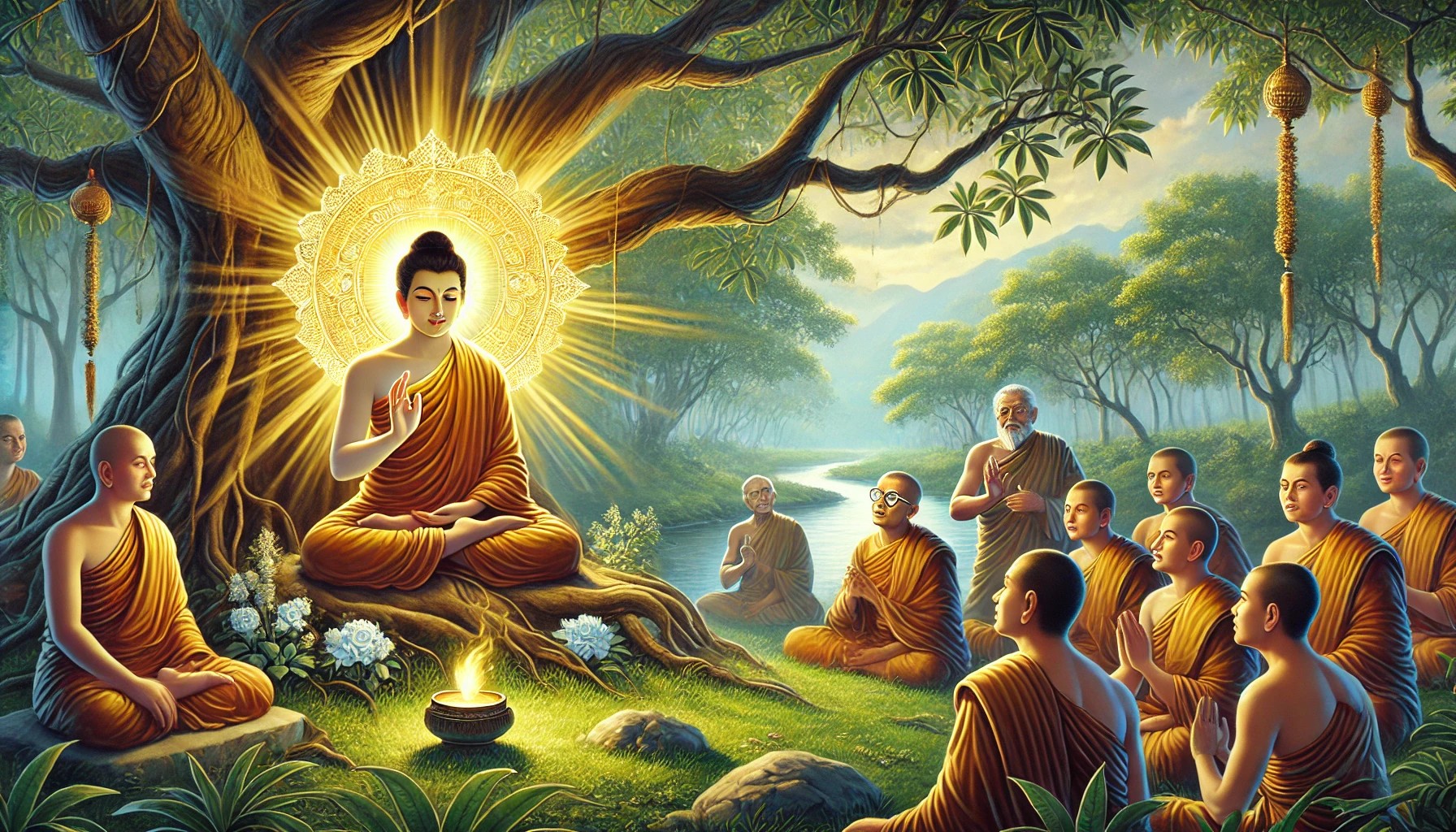
The Buddha thereupon instructed the bhikkhus, saying:
“Bhikkhus, if you hear others slander the Tathāgata, the Dharma, or the Saṅgha, you should not feel sorrow, distress, or anger, nor should you harbor resentment or thoughts of retaliation. Such reactions only create obstacles, preventing you from judging correctly whether what others say is reasonable or mistaken. Likewise, if you hear others praising the Tathāgata, the Dharma, or the Saṅgha, you should not feel delight or pleasure, for this too creates obstacles and prevents you from judging correctly whether what is said is reasonable or mistaken.”
The Buddha then continued:
“Bhikkhus, ordinary people usually praise the Tathāgata only on the basis of minor, superficial, and worldly forms of moral conduct—such as observing the five precepts, practicing the ten wholesome actions, living a frugal and disciplined life by right livelihood, going for alms, or not accumulating possessions. They are unable to praise the Buddha on the basis of the profound, subtle, and supremely radiant Dharma that the Tathāgata has realized. Only praise that is grounded in the profound, subtle, and supremely radiant Dharma realized by the Tathāgata is truly praise of the Buddha in accordance with reality.”
What, then, is the profound, subtle, and supremely radiant Dharma realized by the Tathāgata?
In the Buddha’s time, wandering ascetics and brahmins held various forms of wrong knowledge and wrong views. When classified and summarized, these amounted to views such as complete eternalism, partial eternalism, doctrines of no cause and no conditions, theories of finitude and infinitude, evasive skepticism, doctrines of perception, doctrines of non-perception, doctrines of neither-perception-nor-non-perception, annihilationism, and incorrect views of nirvāṇa in the present life. Altogether, these formed ten categories comprising sixty-two kinds of views, known as the “Sixty-Two Views.” These sixty-two views are like a great fishing net cast into a small pond, ensnaring all the wrong knowledge and wrong views in the world.
The profound, subtle, and supremely radiant Dharma realized by the Buddha is precisely the transcendence of these sixty-two views. It consists in clearly and truthfully understanding, within the everyday process of the six sense faculties encountering the six sense objects, the true causes for the arising of cognition and feeling, as well as the methods for uprooting the defilements they give rise to: how cognition and feeling lead beings, through craving, into attachment and indulgence; how such indulgence, under conditions of impermanence and change, turns into suffering and danger; and how the noble ones transcend and liberate themselves from this process.
Because they are able to transcend and be liberated, the noble ones cut off the very root that propels the cycle of rebirth into the next life—just as when the root of a great tree with luxuriant branches and leaves is severed, the tree withers away and never grows again. This is the profound, subtle, and supremely radiant Dharma realized by the Buddha.
To praise the Buddha on this basis—this alone is true praise.