时间:04/06/2024 04/07/2024
地点:星湖禅修中心
主讲:净真
佛法知识
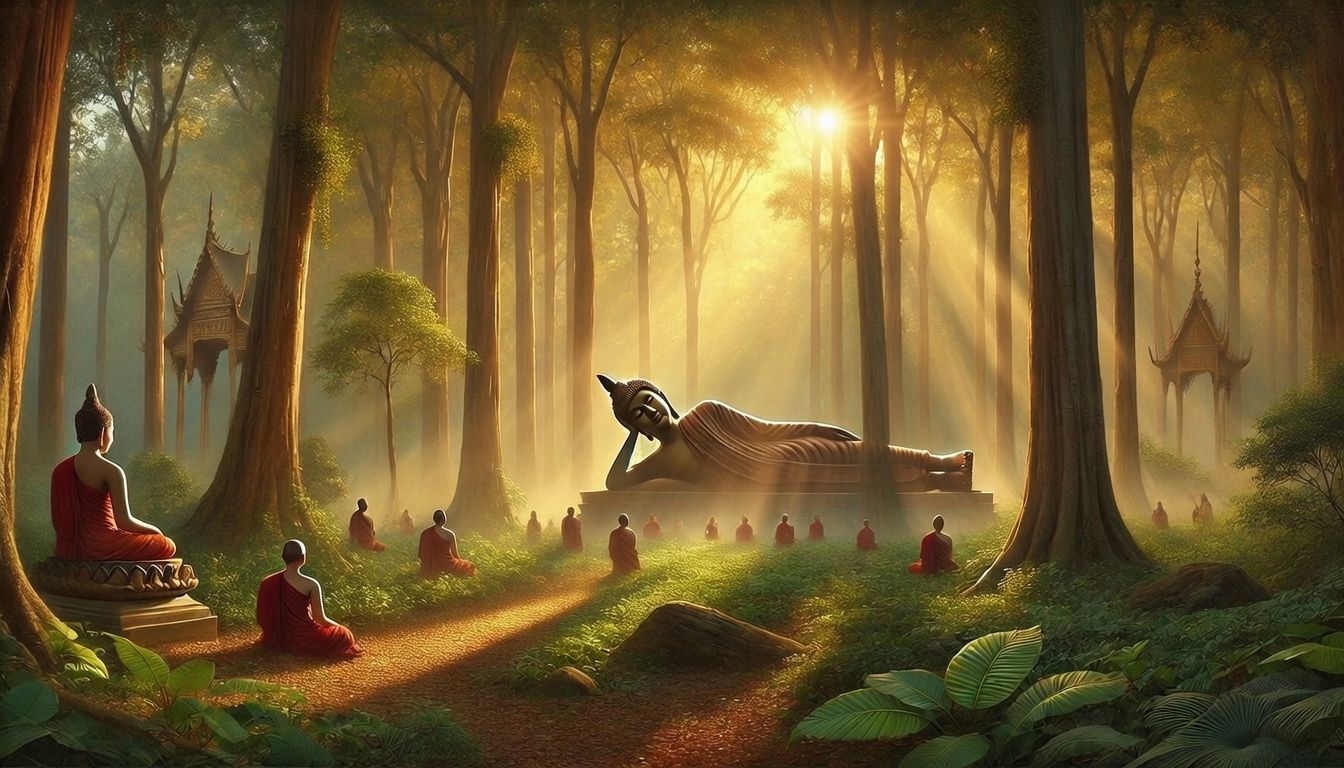
佛陀入涅槃的启示
佛陀的入涅槃,并不是一场象征性的死亡仪式,也不是宗教意义上的“升天”或“回归本源”。在佛法体系中,入涅槃本身就是对其全部教法的最终确认与实践完成。理解佛陀入涅槃的启示,关键不在情感纪念,而在逻辑含义。
首先,佛陀的入涅槃明确否定了“永恒导师依赖”。佛陀并未以不死、神化或继续主宰教团的方式结束一生,而是如实示现生、老、病、死这一必然过程。这一行为本身即是宣告:佛法不依附于任何个体存在,觉悟不是通过与导师的持续关系而获得的。
在入涅槃前,佛陀明确指出“以法为师”。这并非一句劝诫,而是制度性安排。它意味着,在佛陀不在之后,判断修行是否正确的唯一标准,不是人、不是地位、不是传承,而是是否符合对现实的如实观察,是否真实地减少无明与苦。这一原则,从根本上阻断了个人权威的绝对化。
其次,佛陀的入涅槃揭示了佛法对无常的彻底贯彻。佛法反复说明,一切有为法皆无常,而佛陀本人并未将自己排除在这一规律之外。若佛陀以“例外”的方式存在,佛法关于无常的论述便会自我瓦解。正因为佛陀同样入灭,佛法才在逻辑上保持一致。
第三,入涅槃澄清了“涅槃”并非死亡状态。佛陀在生前已证涅槃,入涅槃并不是在死亡时“进入”某种境界,而是五蕴彻底止息后,不再有任何条件使苦继续显现。死亡只是因缘的终止点,而非解脱的发生点。这一区分,直接否定了将涅槃理解为来世归宿或超自然去处的误解。
从修行角度看,佛陀的入涅槃传递了一个清晰信号:佛法不是陪伴性的依赖关系,而是一条必须被独立实践的道路。佛陀不再“留下”,正是为了防止修行者将注意力投向人物、纪念与情感,而偏离对自身无明的观察。没有佛陀可依,修行只能回到对现实本身的面对。
在教团层面,佛陀的入涅槃构成了一次有意的“权力真空”。他未指定继承者,也未授权任何个人代表其意志。这使得佛法在结构上无法被合法垄断,只能通过是否符合正见、是否有效止苦来维持其正当性。任何脱离这一标准的权威主张,在佛法内部都缺乏根基。
更深一层看,佛陀入涅槃的启示在于:觉悟并不等于存在的延续。觉悟是认知结构的完成,而非生命形态的延长。当认知不再制造苦,是否继续存在已不构成问题。佛陀的入灭,是对这一立场的彻底贯彻。
因此,佛陀的入涅槃并非“失去导师”,而是将责任完整地交还给实践者本身。佛法在此刻从“由佛宣说的法”,彻底转化为“必须被亲证的法”。这是佛陀一生弘法的最终逻辑落点。
Date: 04/06/2024 04/07/2024
Location: Star Lake Meditation Center
Teacher: Sara
Dharma Knowledge
The Implications of the Buddha’s Parinirvana
The Buddha’s parinirvana was not a symbolic death, nor a religious ascent or return to an absolute source. Within the framework of the Dharma, parinirvana represents the final confirmation and completion of the Buddha’s teaching in practice. Its significance lies not in mourning, but in its logical implications.
First, the Buddha’s parinirvana decisively rejects dependence on an eternal teacher. The Buddha did not conclude his life by becoming immortal, divine, or continuing to govern the community. He demonstrated aging, illness, and death as unavoidable processes. This act itself makes a clear statement: the Dharma does not rely on the continued existence of any individual, and awakening is not sustained through an ongoing personal relationship with a teacher.
Before his passing, the Buddha explicitly instructed his followers to take the Dharma as their teacher. This was not a moral exhortation, but a structural principle. After the Buddha’s death, the validity of practice would no longer be judged by persons, ranks, or lineages, but by whether it accords with direct observation of reality and effectively reduces ignorance and suffering. This principle prevents the absolute elevation of personal authority.
Second, the Buddha’s parinirvana fully embodies the Dharma’s teaching on impermanence. The Dharma asserts that all conditioned phenomena are impermanent, and the Buddha did not exempt himself from this law. Had he existed as an exception, the teaching of impermanence would have collapsed internally. His passing preserves the internal coherence of the Dharma.
Third, parinirvana clarifies that nirvana is not a post-mortem state. The Buddha realized nirvana during his lifetime. Parinirvana does not mean “entering” nirvana at death, but the complete cessation of the aggregates, after which no conditions remain for suffering to arise. Death marks the end of conditions, not the moment of liberation. This distinction directly counters interpretations of nirvana as a heavenly destination or supernatural realm.
From the standpoint of practice, the Buddha’s parinirvana delivers a clear message: the Dharma is not a relationship of emotional dependence, but a path that must be walked independently. The absence of the Buddha prevents practitioners from shifting their focus toward personality, commemoration, or devotion, and redirects attention to direct examination of ignorance itself. With no Buddha to rely on, practice necessarily returns to reality.
At the institutional level, the Buddha’s passing created an intentional vacuum of authority. He appointed no successor and authorized no personal representative. As a result, the Dharma cannot be legitimately monopolized. Its legitimacy rests solely on whether teachings align with right understanding and effectively end suffering. Any authority claim detached from this criterion lacks foundation within the Dharma.
At a deeper level, the Buddha’s parinirvana conveys a final insight: awakening does not require the continuation of existence. Awakening is the completion of cognitive understanding, not the extension of life. When the mechanisms that generate suffering have ceased, continued existence is no longer a problem to be solved. The Buddha’s passing fully embodies this position.
Thus, the Buddha’s parinirvana is not the loss of a teacher, but the full transfer of responsibility to practitioners themselves. At this point, the Dharma moves from being “a teaching spoken by the Buddha” to “a truth that must be personally verified.” This is the final logical conclusion of the Buddha’s life of teaching.