时间:12/28/2024 12/29/2024
地点:星湖禅修中心
主讲:净真
佛法知识
饿鬼道的痛苦
在佛法中,饿鬼道并非神话式的恐怖描写,而是对一种特定存在状态的结构性说明。理解饿鬼道,关键不在于把它当作遥远的他界,而在于看清它所揭示的心理机制、因果逻辑与痛苦形态。饿鬼之苦,本质上是欲望失控与满足不可能性之间的持续张力。
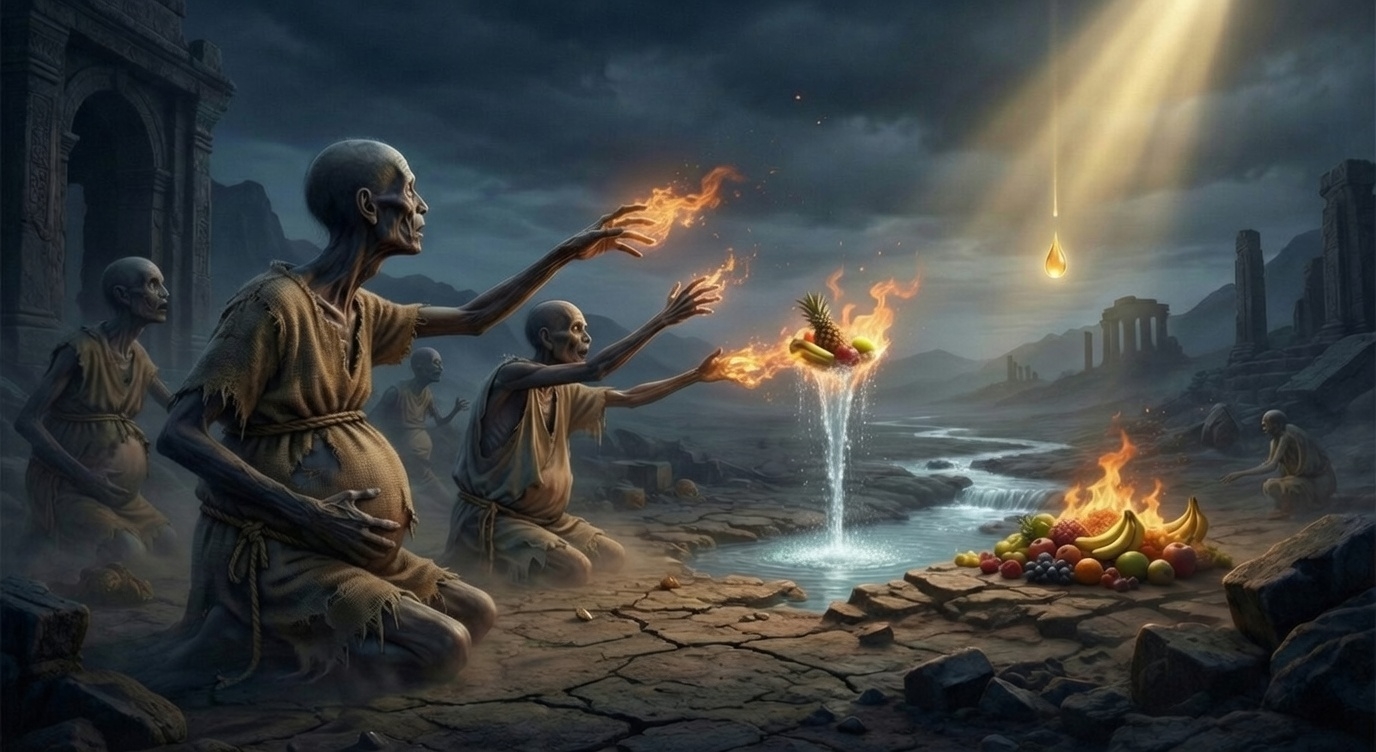
从定义上看,饿鬼道指一种以“强烈渴求而无法满足”为核心特征的存在状态。经典对其形象的描述——腹大如鼓、咽细如针、饮食化火——并非为了制造恐惧,而是对其内在结构的象征性表达:欲望无限膨胀,承受与转化能力却极端受限。欲望越强,痛苦越深。
饿鬼道的根本因,是贪欲与执取的长期积累。在因果结构中,饿鬼并非因为“想要”而受苦,而是因为对“必须得到”的执著。当欲望被固化为身份、价值与生存感的核心,一旦条件不足,整个心理系统便持续处于匮乏与焦灼之中。这种状态不依赖外界是否真的贫乏,而取决于内在是否允许满足发生。
饿鬼之苦并不止于物质层面。经典反复强调,其痛苦主要是心理性的:永远不够、永远来不及、永远被剥夺。即使偶然接近所欲之物,也因恐惧失去、比较他人、怀疑不足而无法真正享用。满足在即,却无法成立,这正是饿鬼道最核心的折磨。
进一步看,饿鬼道体现的是“欲望—认知—行为”的恶性循环。欲望驱动行为,行为强化执取,执取遮蔽现实判断,使人无法看见条件、因果与限度。结果并非获得更多,而是感受更少。越追逐,越匮乏;越抓取,越空虚。这一结构在逻辑上自洽,却在体验上极度痛苦。
佛法并未将饿鬼道限定为死后世界。相反,它明确指出,饿鬼状态可以在现世中被完整体验。当一个人被贪欲、嫉妒、占有与比较长期主导,其心态已具备饿鬼道的全部要素:强烈渴求、持续不满、无法止息。这并非比喻,而是状态描述。
因此,理解饿鬼道的意义,不在于恐惧来世,而在于识别当下。当欲望出现时,佛法并不要求压制或否认,而是要求观察其条件、边界与真实功能。一旦看清欲望并非“必须被满足”的实体,而只是条件性生起的过程,饿鬼道的逻辑便开始松动。
从修行角度看,饿鬼道的对治并非贫乏化生活,而是解除“非得不可”的认知结构。通过戒,减少掠夺与比较;通过定,使心不被欲望牵引;通过慧,直接洞见欲望的无常与不可主宰性。当欲望失去绝对地位,满足与不满足便不再构成生存威胁。
饿鬼道的痛苦,揭示的不是世界的残酷,而是认知失衡的代价。它提醒人们:真正制造匮乏的,并非缺少对象,而是无法停止抓取。佛法描述饿鬼道,不是为了渲染惩罚,而是为了提供一面清晰的镜子。
Date: 12/28/2024 12/29/2024
Location: Star Lake Meditation Center
Teacher: Sara
Dharma Knowledge
The Suffering of the Hungry Ghost Realm
In the Dharma, the hungry ghost realm is not a mythological horror story, but a structural description of a specific mode of existence. To understand it properly is not to imagine a distant afterlife, but to recognize the psychological mechanisms, causal logic, and forms of suffering it reveals. The suffering of hungry ghosts arises from the persistent tension between unrestrained craving and the impossibility of satisfaction.
By definition, the hungry ghost realm is characterized by intense desire coupled with chronic inability to fulfill it. Classical imagery—distended bellies, needle-thin throats, food turning to fire—serves not to frighten, but to symbolize an internal structure: craving expands without limit, while the capacity to receive and digest experience collapses. The stronger the craving, the sharper the suffering.
The fundamental cause of this state is the long-term accumulation of greed and attachment. In causal terms, hungry ghosts do not suffer simply because they want, but because wanting hardens into necessity. When desire becomes the core of identity, value, and security, insufficient conditions trigger continuous distress. The suffering depends less on external scarcity than on the internal refusal to allow sufficiency.
Importantly, the suffering of hungry ghosts is primarily psychological. It manifests as a constant sense of lack: never enough, never in time, never secure. Even when desired objects are momentarily obtained, enjoyment fails due to fear of loss, comparison, suspicion, or dissatisfaction. Fulfillment approaches but never stabilizes. This near-miss is the defining torment of the hungry ghost realm.
At a deeper level, the hungry ghost realm illustrates a self-reinforcing loop between desire, cognition, and action. Desire drives action; action reinforces attachment; attachment distorts perception, obscuring conditions, limits, and causality. The result is not increased gain, but diminished experience. The more one pursues, the more one lacks; the more one grasps, the emptier one becomes. The logic is internally consistent, but experientially devastating.
The Dharma does not restrict the hungry ghost realm to postmortem existence. On the contrary, it explicitly recognizes that this state can be fully lived in the present life. Whenever a person is dominated by craving, envy, possession, and comparison, the essential conditions of the hungry ghost realm are already present: intense desire, persistent dissatisfaction, and inability to rest. This is not metaphor, but phenomenological description.
The value of understanding the hungry ghost realm lies not in fearing future rebirth, but in recognizing present conditions. When desire arises, the Dharma does not demand suppression or denial. It requires observation—seeing its conditions, limits, and actual function. Once desire is understood not as an absolute necessity but as a conditioned process, the logic of the hungry ghost realm begins to loosen.
From the standpoint of practice, the antidote to the hungry ghost realm is not enforced deprivation, but the dismantling of the belief that fulfillment is indispensable for existence. Ethical restraint reduces grasping and comparison; mental stability prevents the mind from being dragged by craving; wisdom directly percees the impermanence and non-sovereignty of desire itself. When desire loses its absolute status, satisfaction and deprivation cease to threaten survival.
The suffering of the hungry ghost realm reveals not the cruelty of the world, but the cost of cognitive imbalance. It demonstrates that scarcity is often manufactured not by lack of objects, but by the inability to stop grasping. The Dharma presents the hungry ghost realm not as punishment, but as a clear diagnostic mirror.